We’ve found that preparing your Castleford home for painting requires timing projects between August and early September when humidity sits at 37% and temperatures stabilize. You’ll need to power wash at 1,500-2,500 PSI, treat any mold with a 1:3 bleach solution, and allow 24-48 hours for proper substrate drying. We always account for the region’s 34°F daily temperature swings and freeze-thaw cycles when selecting primers and coatings. Our detailed guide below covers climate-specific preparation techniques that’ll guarantee lasting results.
Key Takeaways
- Power wash exterior at 1,500-2,500 PSI and allow 24-48 hours drying time before painting.
- Schedule exterior painting for August through early September when humidity averages 37% and precipitation is minimal.
- Repair all cracks, holes, and wood rot, then apply primer before top coat application.
- Protect landscaping with 6-mil polyethylene sheeting secured with weighted anchors during surface preparation and painting.
- Avoid painting below 35°F as latex paint curing slows significantly in cold temperatures.
Understanding Castleford’s Unique Climate Challenges
Before selecting paint systems and surface preparation methods for Castleford properties, we must account for the region’s extreme thermal cycling. Our climate subjects exterior coatings to 34°F daily temperature variations during summer months, while winter conditions drop to 21°F minimums. These extreme temperature swings cause substrate expansion and contraction that compromises paint adhesion and film integrity.
We’re dealing with winter snowfall averaging 16-18 inches annually, with January contributing 4.4 inches alone. This moisture exposure, combined with freeze-thaw cycles, creates unique substrate stress. Our coating systems must withstand temperatures ranging from summer highs of 89°F to winter lows below freezing.
The continental climate’s 70 precipitation days and low humidity averaging 49-55% demand flexible, breathable film formulations that accommodate Castleford’s distinctive environmental parameters.
Essential Surface Preparation Steps for Long-Lasting Results
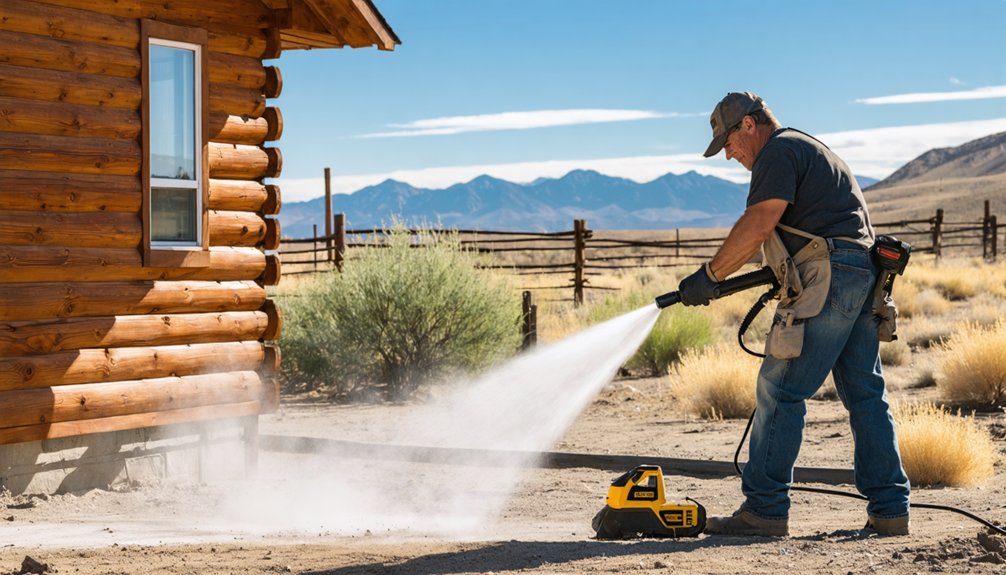
We’ve established Castleford’s climate challenges—now we’ll execute proper surface preparation to guarantee your paint adheres correctly and withstands local weather conditions. Before any coating application, we must remove all contaminants through power washing at 1,500-2,500 PSI, maintaining a 12-18 inch distance from surfaces to prevent substrate damage.
After treating mold with a 1:3 bleach-to-water solution and completing all repairs, we’ll allow 24-48 hours of drying time to achieve ideal moisture content for primer adhesion.
Cleaning and Repairing Surfaces
Professional painters understand that proper surface preparation determines paint longevity more than any other factor in the coating process. We’ll begin with thorough cleaning using TSP solution to break down kitchen grease and bathroom residue. For exterior applications, we recommend power washing to eliminate mold, mildew, and weathering.
After cleaning, we’ll scrape all loose paint and failed coatings with proper tools.
Once surfaces are clean, we’ll patch cracks and holes using quality filler compounds. On stucco, we repair any damage requiring credit card-width crack filling. Wood rot needs addressing before primer application. We’ll sand patched areas smooth, followed by complete dust removal with tack cloths.
Throughout this process, we prioritize sustainable disposal of debris and coating materials, protecting both your investment and our Castleford community.
Drying Time Considerations
Surface preparation accounts for 80% of paint project success, yet most homeowners underestimate how environmental conditions affect drying times between each critical phase. We’ve found that proper humidity management tactics require monitoring levels between 40% and 70% for ideal results. When relative humidity exceeds 90%, evaporation slows dramatically, extending latex paint drying from the standard 4-6 hours to several days.
Temperature considerably impacts our timeline. Below 60°F, water-based paints take twice as long to cure, while conditions under 35°F prevent proper setting entirely. We recommend early fall applications when temperatures remain steady between 60°F and 85°F.
Light airflow accelerates solvent evaporation without compromising finish quality. However, avoiding air pollutants remains critical—wind-borne dust particles settle on wet surfaces, requiring meticulous environmental assessment before beginning work.
Timing Your Painting Project With Castleford’s Weather Patterns
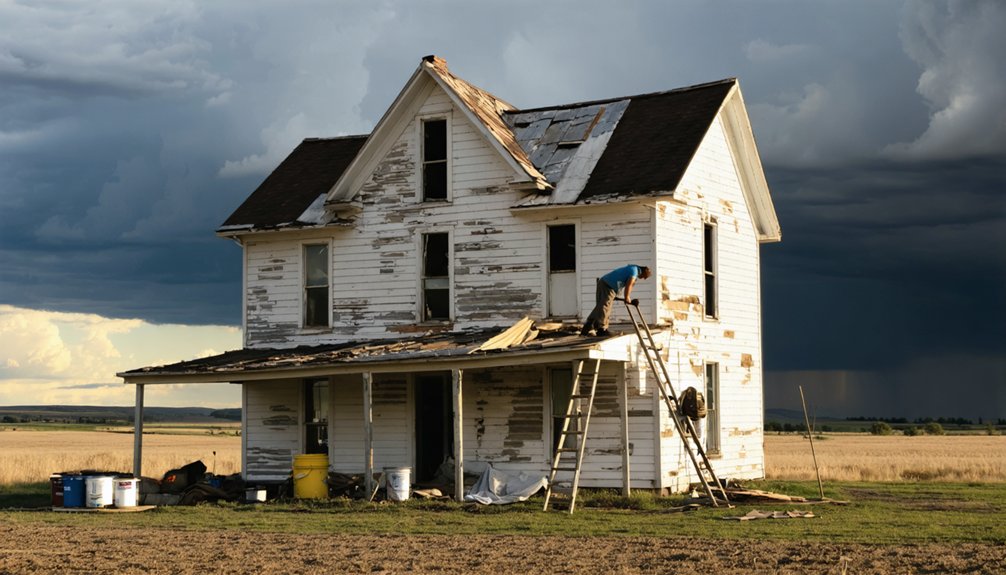
When scheduling exterior painting in Castleford, we prioritize August through early September as the ideal window for maximum paint performance. Weather’s influence on painting becomes evident in our region’s 37% humidity and minimal 0.29-inch precipitation during August, creating optimal conducive conditions. We’ve found timing your paint project around these metrics guarantees proper adhesion and film formation.
Our dry continental climate delivers 214 sunny days annually, yet we avoid March through early May when humidity peaks at 59% and temperatures fluctuate near freezing at night. The mid-80s temperatures and 11 mph wind speeds in late summer facilitate consistent drying rates without surface contamination. We strongly discourage winter applications when temperatures drop to 20°F, preventing proper molecular bonding. September remains viable with 77°F highs, though evening temperatures require adjusted scheduling protocols.
Protecting Your Interior Spaces During the Painting Process
Setting up thorough interior protection systems prevents costly damage and streamlines our painting workflow in Castleford homes. We’ll lay heavy-duty canvas drop cloths on floors, securing them with masking paper underneath for uninterrupted work surfaces. Plastic sheeting protects furniture and fixtures while painter’s tape—particularly FrogTape with its polymer seal—creates clean lines along baseboards, crown molding, and trim. We’ll cover electrical outlets and appliances to prevent splatter contamination.
Proper ventilation remains critical for minimizing health hazards. We open windows and run ceiling fans to disperse fumes, maintaining air circulation throughout the project. For solvent-heavy applications, we’ll deploy exhaust fans for 2-3 days post-completion. Our team selects low-VOC, indoor-grade paints and wears appropriate PPE including goggles, gloves, and respirators when handling chemical strippers or harsh cleaners.
Safeguarding Your Exterior and Landscaping
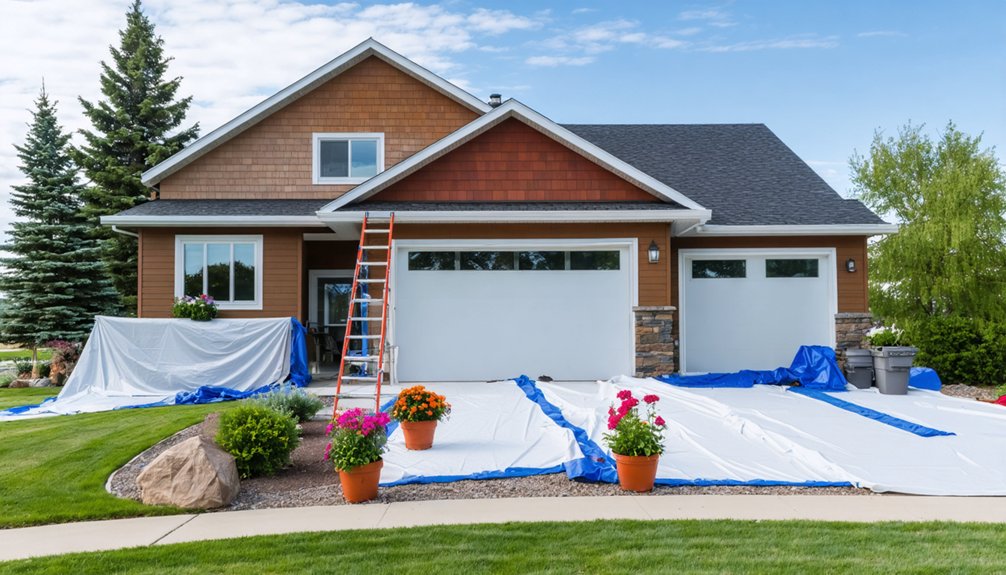
Before initiating exterior paint applications in Castleford, we’ll establish detailed protection protocols that shield landscaping elements from high-pressure washing, primer overspray, and topcoat atomization. Our vegetation preservation methodology involves strategic placement of 6-mil polyethylene sheeting over shrubs and perennials, secured with weighted anchors resistant to Idaho’s prevailing winds. We’ll trim back foliage contacting siding to guarantee sufficient airflow and prevent moisture entrapment post-application.
Our team employs water-based coating systems that minimize phytotoxicity risks during the finishing process. Drop cloths protect ground-level plantings from power washing runoff and scraping debris. Following surface preparation and dual-coat application, we implement plant rejuvenation protocols—thoroughly irrigating exposed vegetation and monitoring for stress indicators. This exhaustive approach safeguards your landscape while your home’s exterior achieves ideal coating adhesion and longevity.
Choosing the Right Paint for Idaho’s Dry Continental Climate
Our climate-optimized approach includes:
- Premium UV-resistant formulations that protect your investment against relentless high-altitude sunlight
- Desert-tone palettes—terracotta, sand, muted earth colors—that connect your home to our shared landscape
- High-grade weather-resistant systems engineered for temperature fluctuations and extended dry periods
- Rapid-cure technologies designed for our low-humidity intermontane environment
This specification strategy guarantees long-term performance in our unique continental conditions.
Addressing Temperature Fluctuations in Your Paint Selection
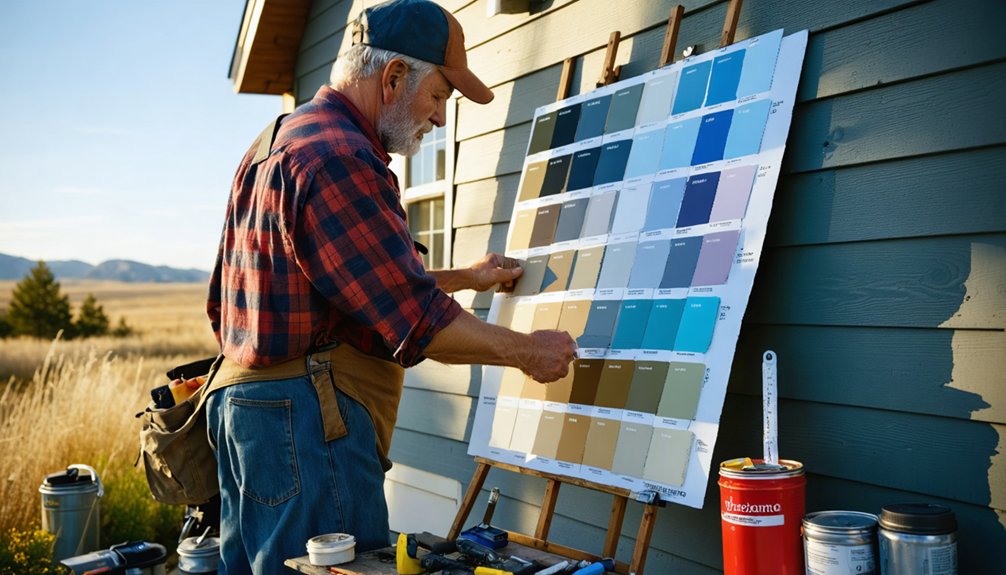
We’ll need to account for Castleford’s dramatic temperature swings when selecting your exterior paint formulation. The seasonal range between winter lows and summer highs creates expansion-contraction cycles that stress paint film, while overnight temperature drops can prevent proper curing if we’re not careful.
Let’s examine how specific paint chemistries perform across these extremes and identify application windows that guarantee suitable bonding and durability.
Seasonal Temperature Range Impacts
Castleford’s 68°F annual temperature swing—from winter lows of 21°F to summer peaks of 93°F—demands paint formulations engineered for extreme thermal expansion and contraction. We’ve learned that seasonal temperature swings directly impact substrate movement, adhesion performance, and coating integrity throughout our harsh climate cycles.
When timing paint application, we prioritize these critical factors:
- Summer stability (June-August): Consistent 80-89°F temperatures minimize cure-time variables and maximize cross-linking efficiency
- Spring volatility (March-May): 17°F monthly temperature jumps create unpredictable substrate conditions requiring adaptive scheduling
- Fall window closure: September’s 77°F rapidly declining to November’s 47°F compresses application timelines
- Winter freeze-thaw cycles: 16-18 inches annual snowfall combined with sub-freezing temperatures compromises fresh coating adhesion
Our community understands that matching paint chemistry to Castleford’s extreme thermal environment guarantees long-term performance.
Paint Formulation for Extremes
When ambient temperatures fluctuate between 21°F and 93°F throughout the year, paint chemistry becomes the determining factor between coating failure and multi-decade performance. We’re specifying formulations based on molecular structure: acrylics handle –10°C to 80°C operational windows, while epoxies extend that range to –40°C through 120°C before degradation occurs.
For Castleford’s temperature extremes, we’ll implement viscosity control strategies through material acclimatization—bringing products to 70°F minimum before application, regardless of ambient conditions. This guarantees ideal product temperatures that prevent the flash-off failures we see above 85°F or the curing defects below 60°F.
We’re monitoring substrate temperatures specifically, since paint assumes surface temperature within seconds of contact. Climate-controlled spray environments aren’t optional here; they’re fundamental to achieving proper film formation and adhesion in our region’s demanding conditions.
Maximizing Castleford’s 214 Sunny Days for Exterior Work
Strategic scheduling transforms Castleford’s abundant sunshine into a competitive advantage for exterior painting projects. We’ll help you leverage 214 annual sunny days—exceeding the national average—through effective project scheduling that maximizes ideal conditions.
Ideal Planning Windows:
- June-September delivers consistent sunshine with minimal precipitation (0.14″-0.29″), guaranteeing uninterrupted application schedules
- Summer temperatures of 87-89°F with 36-37% humidity accelerate proper curing and film formation
- 295 precipitation-free days annually provide extensive booking flexibility for your timeline
- Morning-to-evening work periods extend throughout 13.9-hour summer daylight cycles
We recommend targeting July-August for time-sensitive projects, mitigating weather variances through data-driven forecasting. Spring months (April-May) require flexible scheduling around 1.07″-1.37″ precipitation patterns. This strategic approach ensures your investment receives ideal application conditions while maintaining our community’s quality standards.
Preparing for Low Humidity and Minimal Precipitation
With Castleford’s average annual humidity ranging from 36-37% during peak painting season, maintaining ideal moisture levels requires proactive environmental controls. We’ll need to monitor conditions closely, as readings below 40% RH risk overly dry environments that compromise proper paint adhesion and curing. Installing digital hygrometers provides real-time tracking throughout your project timeline.
When conditions dip too low, we recommend enhancing ambient air circulation without introducing excessive dryness. Position fans strategically to maintain steady airflow while avoiding direct surface contact.
For humidity spikes exceeding 50% RH, deploy dehumidification equipment 1-2 days before application. This targeted approach guarantees your surfaces remain within the ideal 40-50% RH range, preventing both flash-drying defects and prolonged curing times that compromise your finish quality.
Creating Proper Ventilation in Comfortable Indoor Conditions
We’ll establish ideal airflow patterns through strategic window placement and mechanical ventilation to maintain consistent drying conditions while controlling VOC exposure.
Cross-ventilation between opposing openings creates the pressure differential needed to evacuate contaminated air, while exhaust fans positioned in window frames provide continuous air exchange throughout the application and curing phases.
Temperature regulation between 50-85°F guarantees proper paint flow and film formation without compromising the ventilation system’s effectiveness.
Opening Windows Strategically
Proper window positioning creates cross-breeze airflow that’s essential for maintaining safe indoor air quality during paint application. We’ll leverage Castleford’s mild climate by opening windows on opposite sides of each room, establishing directional airflow that carries VOC emissions outside. This cross-ventilation technique dramatically improves air exchange rates while maintaining ideal airflow throughout your workspace.
Strategic ventilation delivers these critical benefits:
- Reduces harmful fume concentration, protecting your family from headaches and respiratory irritation
- Accelerates paint curing and evaporation, especially for oil-based formulations
- Prevents moisture condensation that compromises surface adhesion
- Extends your paint job’s longevity up to 15 years through proper drying conditions
We’ll maintain monitoring ventilation effectiveness by testing multiple window configurations. Keep windows open 48-72 hours post-application until air feels fresh and odor-free.
Using Fans Effectively
Since cross-ventilation establishes baseline airflow, supplementing it with strategically positioned fans transforms adequate ventilation into perfect fume management. We’ll position box fans in windows with blades facing outward, expelling contaminated air while drawing fresh air inward.
Understanding air circulation mechanics allows us to prevent direct airflow onto wet surfaces—avoiding bubbles, streaks, and uneven curing.
For larger rooms, we’ll implement dual-fan setups: one introducing fresh air, another removing fume-laden air. We’ll seal gaps around fans with tape or cardboard to maximize efficiency and prevent air leakage.
This systematic approach to fume dispersal accelerates evaporation rates while maintaining consistent air exchange. We’ll run exhaust fans throughout the painting process and several hours afterward, ensuring our Castleford home maintains excellent indoor air quality during every project phase.
Temperature Control During Painting
While ventilation systems remove harmful fumes, they’ll prove counterproductive if temperature fluctuations compromise paint adhesion and curing. We’ve found that maintaining substrate surface temperature between 60°F and 75°F guarantees ideal film formation, even when circulating air through your workspace.
Here’s what we monitor during winter projects:
- HVAC system consistency prevents the frustration of lap marks and uneven sheen
- Space heater placement eliminates cold spots that delay bonding
- Humidity level fluctuations between 40% and 70% protect against bubbling disasters
- Digital thermometer readings at wall surfaces confirm readiness before application begins
We position blow heaters strategically to circulate warm air while fans direct fumes outward. This integrated approach maintains the 60°F minimum threshold without sacrificing ventilation quality, ensuring your Castleford home receives professional-grade results.
Frequently Asked Questions
How Long Does Exterior Paint Typically Last in Castleford’s Climate?
We’ll typically see exterior paint durability reach 7–10 years here, though Castleford’s local climate conditions—intense UV exposure, freeze-thaw cycles, and low humidity—can shorten that timeline without proper surface preparation and premium coating systems.
Should I Hire Professional Painters or Do It Myself?
We recommend hiring professionals when cost comparison shows DIY considerations like time investment (44-78 hours), hidden expenses, and quality risks outweigh initial savings. You’ll achieve lasting results while avoiding costly mistakes that require premature repainting.
What Permits Are Required for Exterior Home Painting in Castleford?
We don’t need permits for exterior painting in Castleford—it’s exempt from local code regulations. However, we should verify our paint material requirements meet manufacturer specs and guarantee any hired contractors maintain proper registration with applicable authorities.
How Much Does a Professional Painting Project Cost in Idaho?
We’ll help you understand that professional painting projects in Idaho typically range from $7,497 to $10,143. Local painting contractors provide paint cost estimates averaging $3.64 per square foot for interior work and $1.50-$4.00 for exterior applications.
Can I Paint Over Existing Wallpaper or Must It Be Removed?
You can paint over wallpaper if damage stays under 35%. We’ll guide you through proper wall preparation and primer application, using oil-based products to prevent delamination. Together, we’ll achieve professional results through meticulous surface treatment.