We’ve found that successful interior painting in Burley starts with thorough surface preparation—clean walls with TSP, fill cracks with lightweight joint compound, and sand smooth before priming. We recommend low-VOC, premium-grade paints matched to your specific substrates for superior coverage and durability. Protect your flooring with 12-ounce canvas drop cloths layered over rosin paper, and use FrogTape’s polymer-edge technology for crisp trim lines. Beyond these fundamentals, mastering climate-adjusted application techniques and understanding Burley’s specific humidity considerations will transform your results from adequate to professional-grade.
Key Takeaways
- Clean surfaces thoroughly with mild detergent, fill cracks with joint compound, and sand smooth before painting.
- Select low-VOC, premium paints matched to specific surfaces for better coverage, durability, and indoor air quality.
- Protect floors with canvas drop cloths over rosin paper on hardwood; secure edges with masking tape.
- Apply painter’s tape to trim, outlets, and hardware; use FrogTape with damp cloth for tighter seals.
- Move furniture to room center, cover with plastic sheeting, and use additional protection in high-traffic areas.
Proper Surface Preparation Sets the Foundation for Long-Lasting Results
Surface preparation determines paint longevity more than any other factor in interior painting projects. We begin by thoroughly cleaning all surfaces with mild detergent and warm water, removing dirt, dust, and grease that compromise adhesion.
In kitchens and bathrooms, we use trisodium phosphate (TSP) for effective degreasing. Properly timed repairs follow cleaning—we fill cracks and holes with lightweight joint compound, allowing complete drying before sanding smooth with fine-grit sandpaper. We caulk gaps around trim and windows, ensuring moisture barriers remain intact.
Primer application on bare drywall, stained areas, and patched sections creates uniform adhesion and prevents spot priming issues. Protecting existing surfaces requires painter’s tape along edges and drop cloths covering flooring. We remove outlet covers for complete wall coverage, establishing professional-grade results.
Selecting the Right Paint Products for Burley Homes
We recommend prioritizing three critical factors when selecting interior paints for Burley homes: low-VOC formulations that minimize indoor air quality concerns, premium products that justify their cost through superior coverage and durability, and surface-matched chemistries engineered for specific substrates.
Bear Dynasty’s single-coat matte finish and BEHR PREMIUM PLUS’s flat low-odor formula exemplify modern quick-drying options that reduce project timelines while maintaining breathable indoor environments.
Your paint selection must align with substrate requirements—semi-gloss enamels like BEHR ULTRA SH for high-moisture areas, while flat sheens work best for ceilings and low-traffic spaces.
Low-Odor Quick-Drying Formulas
Modern low-odor, quick-drying paint formulas have revolutionized interior painting in Burley homes by eliminating the traditional drawbacks of extended drying times and overwhelming chemical fumes. We’ve found that zero-VOC formulations like Benjamin Moore Eco Spec and ECOS Paints deliver low odor advantages while ensuring reduced paint exposure for families with chemical sensitivities. Pittsburgh Paints FastDry Enamel achieves touch-dry status in 15 minutes, enabling same-day project completion on trim and cabinetry.
Key Performance Specifications:
- Quick return to service: Odor dissipation within one hour allows immediate room occupancy without extended airing-out periods
- Superior coverage efficiency: Higher solids content in water-based formulas provides exceptional hide with fewer coats required
- Enhanced chemical resistance: Frequent cleaning protocols won’t compromise finish integrity in high-traffic areas
Quality Over Cost
While premium paints command 40–60% higher upfront costs than economy alternatives, Burley homeowners who’ve opted for quality formulations consistently experience 300–400% longer service life between repainting cycles.
We’ve observed that superior paint price point selections deliver 250–400 square feet coverage per gallon versus budget options’ 150–250 range, requiring fewer coats for complete opacity. Premium formulations resist blistering, peeling, and chipping while maintaining color vibrancy under our high-altitude sunlight exposure.
The long term value equation becomes evident when you calculate repainting frequency: quality paints extend 8–12 years interior versus economy grades’ 2–4 year lifespan. Higher solids content verifies uniform sheen, excellent adhesion, and smoother finishes that level properly without streaking. Your investment yields reduced labor costs, fewer material purchases, and superior surface protection throughout ownership.
Surface-Specific Paint Types
Each surface in your Burley home demands distinct paint formulations engineered for specific performance characteristics, substrate adhesion properties, and environmental exposure conditions. We recommend satin enamel primers for walls in family rooms and living spaces, while trim applications benefit from specialized wood treatments like Old Masters Interior Stains paired with precision Purdy® brushes.
High-humidity areas require weather-resistant formulations—PPG Manor Hall and INSL-X® products deliver superior moisture protection for bathrooms and kitchens.
Critical surface-specific considerations:
- Wall applications: PPG’s 2,000+ Voice of Color® selections with innovative paint sheens optimize light reflection
- Trim detailing: Benjamin Moore’s comprehensive line covers maximum edge definition and durability
- Ceiling treatments: Advanced applicators from Wooster Brush Company guarantee flawless overhead finishes
Your local Burley retailers—Pro Paint Inc., Franklin Bldg Supply—stock professional-grade products tailored to Idaho’s climate demands.
Protecting Your Furniture and Flooring During the Painting Process
We’ll address three critical protocols to maintain your property’s condition during interior painting projects: systematic furniture relocation, thorough floor and fixture coverage, and splash damage prevention measures.
Before applying the first coat, we relocate large furniture pieces to the room’s center and group them together, creating continuous perimeter access while protecting items with plastic sheeting and foam padding on vulnerable edges.
Simultaneously, we deploy canvas drop cloths of 12-ounce weight or heavier on hard surfaces and apply appropriate floor coverings—rosin paper for low-pile carpets or secured plastic sheeting for high-pile and shag varieties—ensuring overlapping edges eliminate gaps where paint can penetrate.
Move Furniture Before Painting
Clearing out your workspace stands as the critical first step in achieving professional-grade interior painting results. We recommend organizing furniture layout by either relocating pieces completely to another room or consolidating them in the center for perimeter access. When avoiding furniture damage becomes your priority, employ furniture sliders—fuzzy-side down for hardwood, flat discs for carpet—to move heavy sofas and beds without lifting.
For spray applications, we insist on complete room evacuation to garage or storage pods.
Essential movement protocols include:
- Disassemble complex pieces like cabinets and shelving units for easier handling and thorough paint coverage
- Empty all contents from heavy furniture before relocation, organizing items in labeled boxes for efficient post-project return
- Wrap vulnerable surfaces with moving blankets or cardboard, particularly sharp corners and delicate finishes during transit
Most professional painters expect furniture pre-positioned before arrival.
Cover Floors and Fixtures
Before applying a single stroke of paint, thorough floor and fixture protection determines whether your Burley home emerges pristine or requires costly post-project repairs.
We recommend 12-ounce or heavier canvas drop cloths for superior absorption and stability. Apply drop cloth safety techniques by securing edges with 2-inch masking tape against baseboards, then overlap sections by at least six inches. For carpeted areas, we’ll position plastic sheeting underneath canvas for ideal moisture barriers. Hardwood floors require additional protection boards in high-traffic zones to prevent indentations.
Our floor protection methods include taping all overlaps to eliminate shifting during ladder movement. On tile or laminate, we’ll use slip-resistant materials or secure edges with painter’s tape. Complete coverage prevents paint from seeping into grout lines while protecting valuable surfaces throughout your project.
Prevent Paint Splash Damage
Although drop cloths establish foundational protection, extensive splash damage prevention requires integrating tape-sealing protocols with targeted furniture coverage and application control practices. We’ll implement proper tape sealing techniques by activating FrogTape’s polymer with a damp cloth, creating micro-barriers that prevent paint seepage along trim and baseboards.
For effective furniture covering methods, we completely envelop pieces with plastic sheeting secured to legs, while placing canvas drops in high-traffic zones for slip resistance.
Critical Protection Protocols:
- Precision masking: Apply painter’s tape to electrical plugs, projecting hardware, and hinge tops to block overhead splatter and rolling speckles
- Layered floor defense: Position rosin paper beneath canvas drops on hardwood, preventing penetration from drop cloth shifts
- Controlled application: Maintain steady pacing focused on individual sections, eliminating rushed drips and inconsistent coverage patterns
Essential Tools and Equipment for Professional-Quality Interior Painting
When executing a professional-grade interior paint job, selecting the right tools proves just as critical as choosing quality paint itself. We’ll need premium brushes—2.5-inch angle sash for trim work, synthetic bristles for latex applications. Quality brands like Wooster and Purdy deliver consistent performance.
Premium brushes and quality tools deliver professional results—invest in proper equipment before opening the first paint can.
For broader surfaces, we recommend 9-inch roller frames with microfiber covers paired with extension poles to eliminate neck strain.
Proper preparation requires spackling compound, fine-grit sandpaper, and putty knives for surface corrections. ScotchBlue painter’s tape guarantees crisp lines, while canvas drop cloths effectively protect floors. A painter’s multi-tool handles scraping and can-opening tasks efficiently.
Post-project brush storage maintains bristle integrity for future applications. Remember, paint sheen selection directly impacts final appearance—pair appropriate sheens with corresponding application tools for ideal results.
Mastering Application Techniques for Smooth, Even Coverage
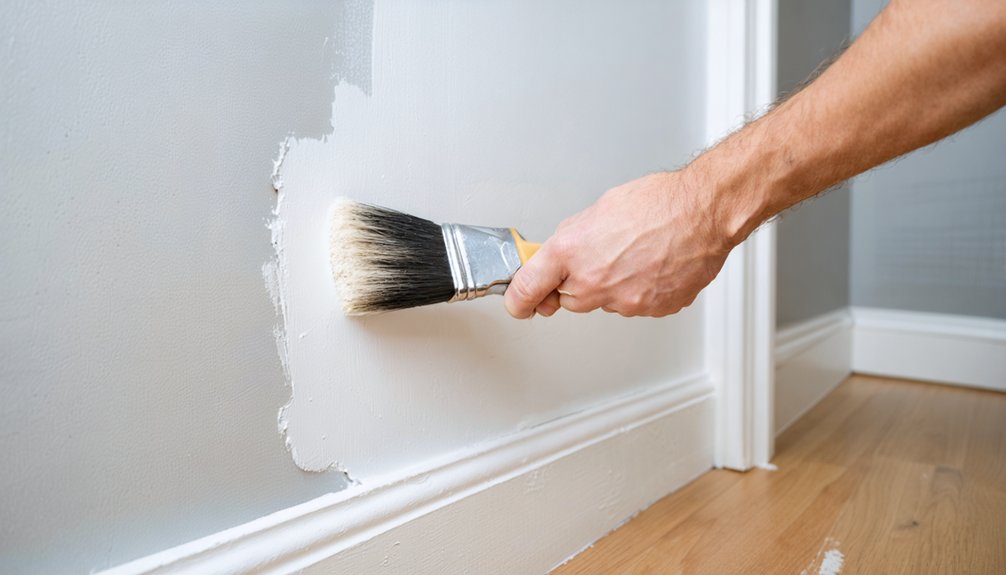
Since successful paint application depends on meticulous surface preparation, we’ll address the foundational elements that separate amateur results from professional-grade finishes.
We dedicate 30-50% of project time to prep work—washing walls, patching imperfections with spackle, and applying primer for ideal adhesion. Our roller selection matches wall texture: short-nap (5-10mm) for smooth surfaces, longer-nap (12-20mm) for textured applications.
For uniform application, we employ the W-pattern technique while maintaining wet edge upkeep throughout each section. We cut in edges with angled sash brushes before rolling, creating seamless shifts.
Professional Application Protocol:
- Apply 2-3 thin coats rather than single thick layers to prevent drips and streaking
- Sand lightly between coats for improved adhesion and texture refinement
- Work systematically in small sections to avoid lap marks and guarantee consistent coverage
Temperature and Climate Considerations for Interior Painting in Idaho
Proper application techniques yield ideal results only when environmental conditions support paint chemistry—a factor that becomes particularly relevant in Idaho’s variable climate. We’ll maintain interior temperatures between 50-85°F for latex formulations, while oil-based products tolerate ranges from 40-90°F.
Idaho’s characteristically low winter humidity (40-70% preferred range) actually promotes steady curing when we’ve implemented proper moisture control through heating systems set to room temperature. For cold-prone spaces, we’re deploying space heaters to prevent surfaces from dropping below 35°F during the critical 36-hour post-application period.
Seasonal preparation includes sealing drafts with weather stripping while cracking windows strategically for VOC dispersion. We’ll monitor local conditions through weather trackers, ensuring our controlled indoor environment prevents the bubbling, cracking, and adhesion failures that temperature extremes cause.
Common Interior Painting Mistakes to Avoid
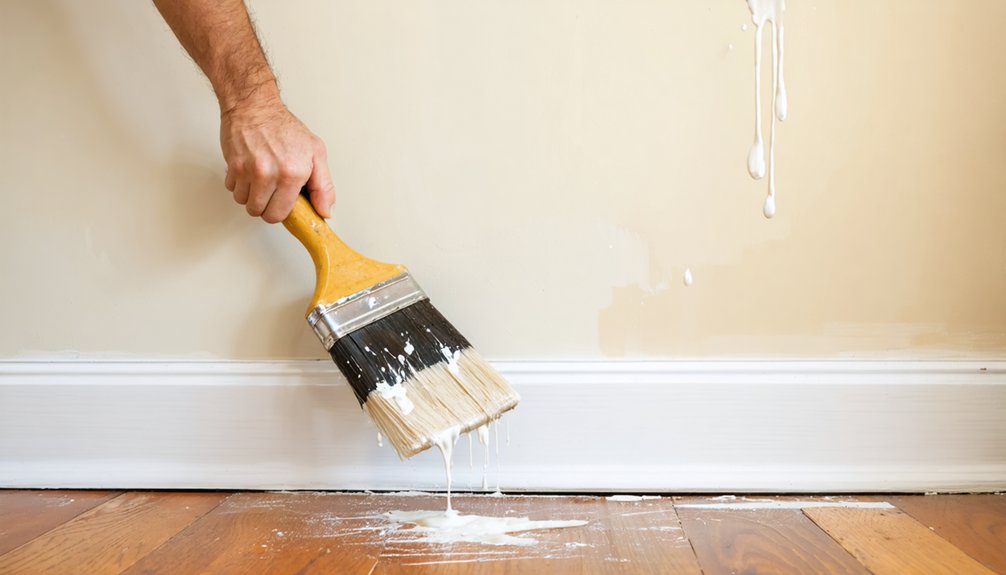
Even experienced painters fall prey to preventable errors that compromise both aesthetics and longevity of interior finishes. We’ve identified critical missteps that undermine professional-grade results in Burley homes.
Surface preparation remains paramount—skipping wall cleaning permits grime accumulation that prevents proper adhesion, causing bubbling and premature failure. Primer omission creates uneven color absorption and necessitates additional coats, particularly over stained or repaired surfaces. Tool selection matters greatly; cheap applicators shed bristles while incorrect roller nap thickness produces streaky, textured surfaces.
Critical techniques we emphasize:
- Avoiding taping mistakes through proper edge sealing and timely removal prevents bleed-through and paint lifting
- Preventing paint pollution via thorough drop cloth coverage and conscientious material disposal protects your environment
- Strategic finish selection matching traffic patterns guarantees durability—semi-gloss for trim, eggshell for living spaces
Working With Local Burley Painting Professionals
Selecting qualified painting contractors in Burley requires systematic evaluation of credentials, service capabilities, and material standards that distinguish professional operations from substandard providers. We’ll find 632 painting contractors listed through the Better Business Bureau directory, enabling exhaustive comparison of ratings and verified customer reviews.
Local professionals like Smith Painting, Premium Finishes, and Gary Hansen Painting, Inc. demonstrate specialized expertise across residential and commercial applications. We should verify contractor referrals through platforms including Angi, HomeAdvisor, and Yelp to assess material quality standards and technical proficiency.
Professional teams employ weather-resistant paints from suppliers like Pro Paint Inc., utilizing advanced application techniques for flawless finishes. Establishing clear project timeline management protocols guarantees execution meets our specifications while maintaining Mini-Cassia region service standards.
Frequently Asked Questions
How Long Should I Wait Before Moving Furniture Back After Painting?
We recommend waiting 24 hours minimum before moving furniture back after painting your walls. This drying time guarantees proper curing while proper ventilation accelerates the process. For ideal results, we suggest allowing latex paint to cure fully over 2-3 weeks.
Can I Paint My Interior Walls During Burley’s Cold Winter Months?
Wondering if winter’s right for painting? We can absolutely paint interiors during Burley’s cold months by maintaining 50-85°F temperatures, ensuring proper ventilation requirements with fans, and allowing adequate paint drying time between coats for ideal results.
What’s the Average Cost per Room for Interior Painting in Burley?
We’re seeing average costs of $1,100 per room in Burley, though paint sheen considerations and specific dimensions affect pricing. We’d recommend gathering local painter estimates ranging from $200 to $2,000 depending on your room’s square footage.
Do I Need to Leave My Home During the Painting Process?
You don’t need to evacuate like a hazmat scenario. We’ll guarantee proper ventilation requirements and safety precautions are met. With low-VOC paints and adequate airflow, you can comfortably stay home while we transform your space professionally.
How Often Should I Repaint My Home’s Interior Rooms?
We recommend repainting every 3-7 years depending on room traffic and conditions. Paint quality and paint sheen greatly impact longevity—higher-grade formulations with appropriate sheen levels extend durability, while moisture-prone areas need more frequent attention.