We recommend painting your Hagerman home’s exterior during spring (April-June) or early fall (September-October) when temperatures consistently stay between 50-85°F. You’ll need to work within a narrow 4-6 hour window due to extreme daily temperature swings exceeding 30°F. We maintain humidity levels between 40-70%, power wash at 1,500-2,000 PSI, and apply alkali-resistant primers over winter salt damage. Our surface preparation includes elastomeric caulk for freeze-thaw cracks and careful monitoring of substrate moisture content. Below, we’ll break down each critical phase of the application process.
Key Takeaways
- Paint during spring (April-June) or early fall (September-October) when temperatures remain consistently between 50-85°F for optimal adhesion.
- Monitor humidity levels between 40-70% and avoid painting during precipitation or when surface temperatures approach dew point.
- Power wash surfaces at 1,500-2,000 PSI and repair freeze-thaw damage before applying alkali-resistant primer over efflorescence.
- Schedule painting during calm morning hours to avoid wind disruption and allow 48-hour drying periods with stable temperatures.
- Maintain substrate moisture content at 12-15% during transition periods and ensure surfaces stay 5°F above dew point.
Best Months to Paint Your Hagerman Home’s Exterior
When planning exterior painting in Hagerman, we prioritize spring and early fall as ideal windows for application. We’ve found April through June offers conducive conditions, with temperatures ranging 50-85°F that promote proper adhesion while minimizing moisture retention issues. During these months, we can complete projects efficiently with extended daylight hours.
Early fall, particularly September through October, provides our second recommended timeframe. The cooler, steady temperatures reduce humidity concerns and enhance paint durability. We schedule applications when overnight temperatures remain above 50°F to prevent film disruption.
For our Hagerman projects, we maintain strict parameters: humidity between 40-70%, consistent temperature windows, and zero precipitation forecasts. We avoid summer’s extreme heat, which accelerates drying and compromises long-term performance. This strategic timing guarantees your investment delivers maximum longevity.
How Temperature Swings Affect Paint Application and Drying
Temperature fluctuations throughout Hagerman’s daily cycles directly impact paint application success and long-term performance. We’ve observed that rapid temperature swings between day and night create significant challenges for proper film formation.
Daily temperature swings in Hagerman create substantial obstacles for proper paint film formation and application success.
When daytime temperatures exceed 60°F but nights drop considerably, dew formation disrupts the coalescence process, allowing moisture infiltration into uncured films. This temperature fluctuations‘ impact manifests as surfactant leaching, adhesion failures, and premature finish degradation.
We require consistent temperatures within the 50°F-85°F range for ideal drying duration—at minimum 48 hours post-application. The surface temperature must remain 5°F above the dew point throughout this critical period.
Spring and fall conditions in our region demand careful monitoring, as seemingly acceptable daytime temperatures can deceive us when evening temperatures compromise film integrity, resulting in shortened paint longevity and increased maintenance requirements.
Managing Hagerman’s Low Humidity for Optimal Paint Adhesion
How substantially does Hagerman’s extreme humidity variation—spanning from July’s arid 19.31% to January’s 68.39%—influence paint adhesion mechanics? We’ve identified critical protocols for our semi-arid climate:
Seasonal Humidity Variation Protocols:
- Summer Application Management (July-August): Accelerated solvent evaporation impacts require pre-moistening substrates and applying primer within 15 minutes of surface preparation to prevent dust accumulation on moisture-depleted wood.
- Winter Optimization (December-January): Higher humidity periods enable extended cure windows—we recommend 48-hour primer curing before topcoat application for maximum chemical bonding.
- Transition Period Adjustments (March-May, September-November): Mid-range humidity demands real-time monitoring; substrate moisture content should measure 12-15% for dimensional stability.
Understanding these solvent evaporation impacts guarantees our community achieves professional-grade adhesion despite challenging climatic conditions.
Hagerman Valley’s unobstructed topography generates sustained wind velocities that directly compromise application integrity and film formation. We monitor meteorological forecasts hourly, tracking wind gusts before mobilizing crews to residential sites.
When velocities exceed twelve miles per hour, airborne particulates contaminate wet surfaces while atmospheric turbulence disrupts spray patterns and causes premature skinning. Our brush handling techniques compensate for moderate wind conditions—we apply additional pressure during strokes and reduce material load per pass to prevent edge lifting.
We schedule critical coating phases during early morning windows when calm prevails, typically between dawn and 9:00 AM. During afternoon wind events, we shift to interior preparation tasks or protected elevation work. Storm systems accompanied by debris require complete operational shutdown.
We resume only after confirming twenty-four-hour stability windows with temperatures maintaining 40-90°F ranges suitable for oil-based formulations.
Surface Preparation Strategies for Idaho’s Steppe Climate
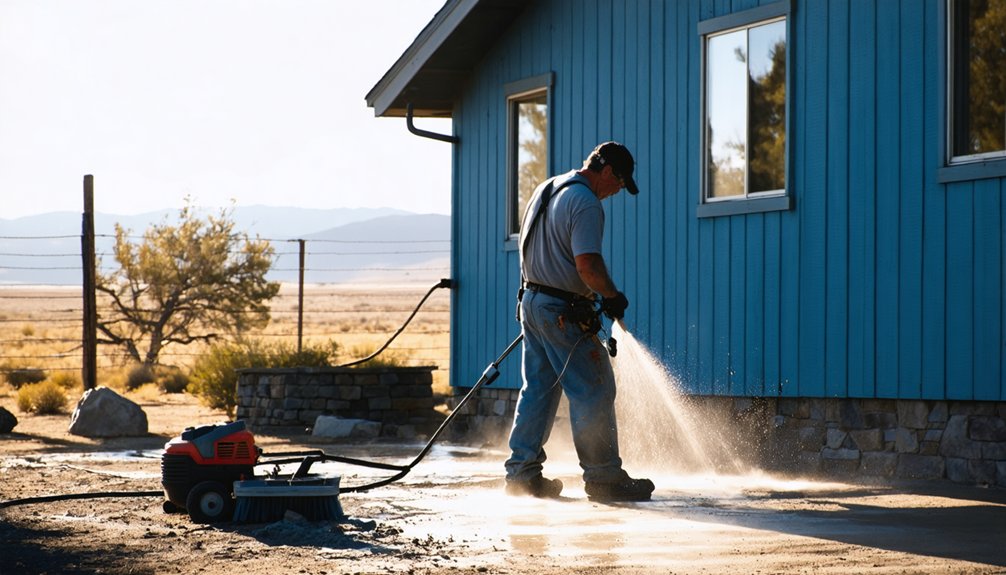
Wind mitigation protocols prove ineffective when the underlying substrate fails structurally. We’re addressing Hagerman’s unique steppe challenges through systematic surface preparation that accounts for moisture management and reflectivity considerations.
Critical preparation sequence:
- Power wash at 1,500-2,000 PSI to remove accumulated dust from 213 annual sunny days, followed by TSP degreasing for oil residues
- Document and repair freeze-thaw damage from January’s 21°F lows—fill cracks with elastomeric caulk rated for our 51.8°F temperature swings
- Apply alkali-resistant primer over efflorescence caused by winter salts interacting with steppe soils
Our low annual rainfall of 10 inches creates persistently dusty conditions requiring thorough substrate exposure. We’re scraping loose paint from winter moisture cycles, sanding repairs smooth, and ensuring proper adhesion before topcoat application. This foundation determines long-term performance.
Frequently Asked Questions
What Paint Types Work Best in Hagerman’s Extreme Temperature Variations?
Hagerman’s 42°F summer temperature swings demand we select 100% acrylic latex formulations. These paint formulations for extreme climate maintain superior paint adherence in temperature fluctuations, ensuring our protective coatings expand and contract without compromising structural integrity.
How Does Hagerman’s Altitude Affect Paint Drying Times and Application?
At Hagerman’s 2,953-foot elevation, we’ll notice 10-20% faster paint curing processes due to reduced atmospheric pressure accelerating solvent evaporation. The altitude also increases ultraviolet radiation exposure, requiring UV-resistant formulations for ideal adhesion and durability in our applications.
Should I Use Primer on All Exterior Surfaces Before Painting?
We recommend priming bare wood and damaged areas, but you can skip it over previous paint that’s clean and sound. For ideal adhesion and durability, we always prime new surfaces, repairs, and dramatic color changes.
How Often Should Homes in Hagerman’s Climate Be Repainted?
We recommend repainting every 10-15 years to maintain exterior paint durability in Hagerman’s semi-arid climate. Our paint maintenance schedules account for UV exposure and temperature fluctuations, ensuring your home’s protective coating functions ideally throughout its service life.
Does Intense Summer Sun Damage Certain Paint Colors Faster Than Others?
Like a magnifying glass concentrating rays, sun exposure intensity accelerates paint color fading unevenly across your palette—we see darker reds, blues, and blacks degrade faster through photodegradation, while lighter neutrals resist UV absorption and maintain film integrity longer.