We’ve found that properly preparing exterior surfaces in Hazelton’s semi-arid climate—where 125 frost days and 35°F daily temperature swings create continuous expansion-contraction cycles—extends paint longevity by 40-60% compared to inadequate surface prep. Your preparation protocol must include pressure washing followed by 24-48 hours of drying time, systematic crack assessment and repair, deglossing with 80-120 grit sandpaper, and application of acrylic latex primer engineered for freeze-thaw resistance. We’ll show you the complete surface preparation methodology and ideal scheduling windows below.
Key Takeaways
- Plan exterior painting between May and September when temperatures exceed 50°F and humidity stays below 60% for optimal results.
- Pressure wash surfaces and allow 24-48 hours drying time before painting to ensure proper adhesion in Hazelton’s climate.
- Remove peeling paint, sand with 80-120 grit sandpaper, and apply primer to create ideal bonding conditions.
- Choose acrylic latex paints that withstand freeze-thaw cycles and UV degradation common in Idaho’s semi-arid environment.
- Select semi-gloss or satin finishes with mildew-resistant formulations to handle Hazelton’s 35-90% humidity fluctuations.
Understanding Hazelton’s Climate and How It Affects Your Painting Project
Hazelton’s semi-arid climate presents four distinct challenges that directly impact paint performance and application success. First, we’re dealing with dramatic 35°F temperature swings between day and night during summer months, which compromise adhesion and curing rates.
Second, the 125-day frost period with temperatures dropping to 0°F creates expansion-contraction cycles that stress painted surfaces. Third, winter humidity peaks at 78% while annual precipitation remains minimal at 10-11 inches, requiring precise timing for exterior surface preparation. Fourth, sustained wind speeds of 17-19 mph demand protected application environments.
We’ve found that optimizing painting conditions means working within the narrow May-through-September window when temperatures stabilize above 50°F and humidity drops below 60%, ensuring proper molecular bonding and long-term durability.
Choosing the Best Time of Year to Paint Your Home’s Exterior
Successful exterior painting projects depend on three critical environmental parameters: temperature stability, humidity levels, and precipitation patterns. In Hazelton, we’ve identified ideal painting seasons based on annual weather patterns that optimize application conditions.
Three environmental factors determine exterior painting success in Hazelton: temperature stability, humidity control, and precipitation timing based on seasonal weather analysis.
Spring (April-June) offers moderate temperatures above 50°F with manageable humidity, though we’ll monitor storm forecasts closely. Summer (July-August) provides consistent drying conditions but requires strategic scheduling—we’ll apply coatings during early morning or evening hours to avoid heat-induced flash drying above 90°F.
Optimal seasonal windows for Hazelton exteriors:
- Fall (September-October): Steady 60-80°F temperatures guarantee proper curing with minimal humidity interference
- Spring application: Best suited for smaller-scale projects completable between precipitation events
- Summer execution: Reserve for large-scale work requiring extended dry periods and UV-resistant formulations
We’ll avoid applications when temperatures drop below 50°F to prevent adhesion failures.
Essential Surface Preparation Steps for Long-Lasting Results
We’ve found that proper surface preparation determines whether your exterior paint job lasts three years or fifteen. The process requires three critical phases: thorough cleaning to remove contaminants that prevent adhesion, extensive damage repair to address structural issues before they worsen, and strategic sanding and priming to create the ideal substrate for paint bonding.
Let’s examine each preparation step with the technical precision necessary for achieving professional-grade results in Hazelton’s climate.
Cleaning and Removing Debris
Before applying primer or paint, proper surface preparation determines whether your coating will last five years or fifteen. We’ll start with thorough cleaning using soap and warm water, scrubbing in circular motions to remove dirt and debris. For stubborn areas, we’ll employ grease-cutting detergent or abrasive sponges.
Critical cleaning protocols include:
- Mold prevention: Mix one part bleach with three parts water for affected areas, focusing on north-facing walls and shaded sections where moisture accumulates
- Cold weather cleaning: Allow 24-48 hours drying time after pressure washing, accounting for Hazelton’s climate conditions
- Deglossing: Use 80-120 grit sandpaper on exterior surfaces, followed by tack cloth removal of fine particles
We’ll scrape any peeling paint, then wipe surfaces with damp cloths to eliminate residue that compromises adhesion.
Repairing Cracks and Damage
After completing the cleaning phase, we’ll conduct a systematic crack assessment across all painted surfaces to identify structural versus cosmetic damage.
For hairline cracks, we’ll remove loose debris and apply wall filler, sanding smooth before priming. Settlement cracks require flexible sealants injected via caulking gun, smoothed with a putty knife to accommodate ongoing movement.
When dealing with significant structural issues, we’ll employ epoxy reinjection techniques—placing ports along cracks at regular intervals, then injecting mixed two-part epoxy from the lowest point upward. For foundation concerns requiring structural reinforcement, we’ll consider piering systems and address water management through proper drainage solutions.
Recurring cracks demand mesh tape reinforcement embedded in joint compound, ensuring durable adhesion before final finishing passes.
Sanding and Priming Surfaces
- Oil-based surfaces: 100- to 150-grit medium sandpaper before primer application
- Water-based surfaces: Fine-grit sandpaper with specialized primer/sealer for stain coverage
- Patched areas: 150-grit smoothing followed by spot priming on all bare surfaces
This systematic approach guarantees our paint adheres properly and delivers professional-grade durability that Hazelton’s climate demands.
Selecting the Right Paint Products for Idaho’s Weather Conditions
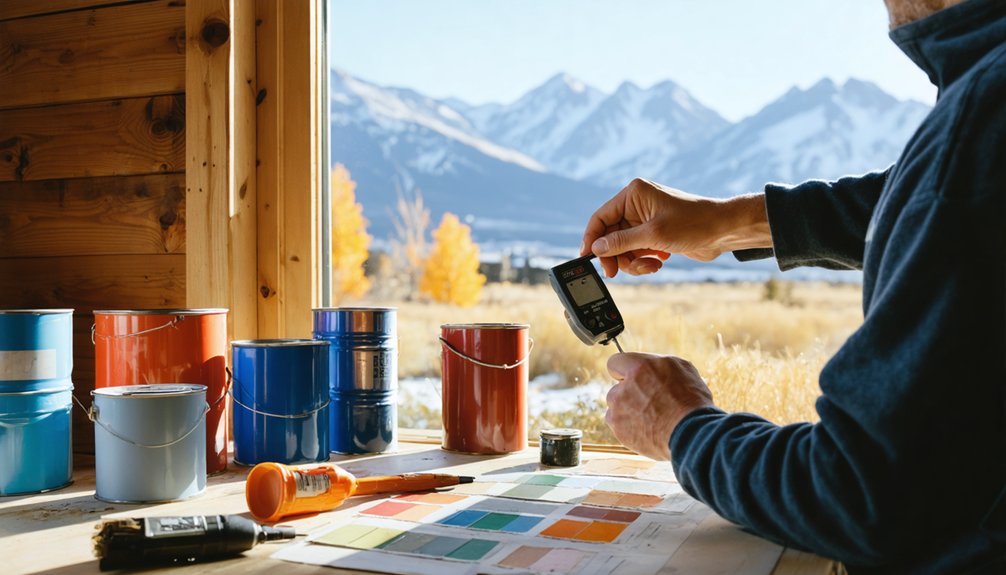
We’ve addressed surface prep—now let’s focus on selecting paint formulations engineered for Idaho’s temperature extremes and moisture variables. Your Hazelton home requires 100% acrylic latex products that maintain film integrity through freeze-thaw cycles while resisting UV degradation in high-altitude sun exposure.
We’ll specify temperature-resistant coatings and moisture-barrier systems that perform within Idaho’s 40-70% humidity range and protect against seasonal precipitation.
Temperature-Resistant Paint Formulations
When selecting temperature-resistant paint formulations for Hazelton’s demanding climate, we must evaluate each coating system’s performance specifications against Idaho’s extreme temperature fluctuations—from sub-zero winters that plunge to -20°F through summer peaks exceeding 100°F.
Specialized silicone based formulas engineered for Northwest conditions deliver high tensile strength and elasticity, expanding and contracting with temperature changes while providing 10-20 years of protection. Their high-solids composition excels in ponding water scenarios and resists UV breakdown effectively.
Durable polyurea coatings offer superior performance metrics for our region:
- Temperature tolerance spanning -50°F to 300°F
- 500% flexibility accommodating concrete expansion through freeze-thaw cycles
- Tensile strength exceeding 6,000 PSI with 98% UV ray blockage
These advanced formulations withstand 300 freeze-thaw cycles, extending surface life 15-20 years while reducing maintenance costs by 50%.
Moisture and Humidity Protection
Idaho’s dramatic humidity fluctuations—ranging from winter peaks of 90% relative humidity in January to summer lows of 35% in August—demand paint formulations engineered specifically for moisture regulation across extreme seasonal changes. We’re optimizing paint selection through targeted moisture mitigation strategies that address Hazelton’s challenging conditions.
Semi-gloss and satin finishes provide superior moisture resistance during our 41-74% daily humidity swings between morning and afternoon periods. We recommend breathable acrylic latex paints that accommodate the 43-66% seasonal variations typical of our region, preventing film failure from trapped vapor.
Low-VOC, mildew-resistant formulations prove essential for eastern Idaho’s 35-90% annual range. For enhanced protection against our 0.83-2.02 inches monthly precipitation variations, elastomeric coatings deliver exceptional waterproofing while maintaining vapor permeability—critical for long-term adhesion and finish integrity.
Tools and Equipment You’ll Need for a Professional Finish
Achieving a professional-grade paint finish requires assembling the right arsenal of tools before you open your first paint can. We’ll need precision instruments for proper brush application techniques, including angle sash brushes for cutting in and long-handle trim brushes for clean edges around molding.
Professional painting demands the right tools from the start—precision brushes like angled sash and long-handle trim varieties ensure expert-level results.
Trade-quality roller systems with 9-inch frames and heavy-duty cages guarantee even coverage on large surfaces, while 4-8 foot extension poles eliminate ladder repositioning.
Essential preparation equipment includes:
- 5-in-1 painter’s multi-tool for scraping, patching, and roller cleaning
- Fine-grit sandpaper and sanding sponges for surface smoothing
- Caulking guns and putty knives for filling imperfections
We must invest in painter’s tape, drop cloths, and hand maskers for protecting adjacent surfaces. Proper storage and cleaning of brushes extends their lifespan greatly—synthetics for latex, natural bristles for oil-based applications.
Addressing Common Exterior Issues Before Painting
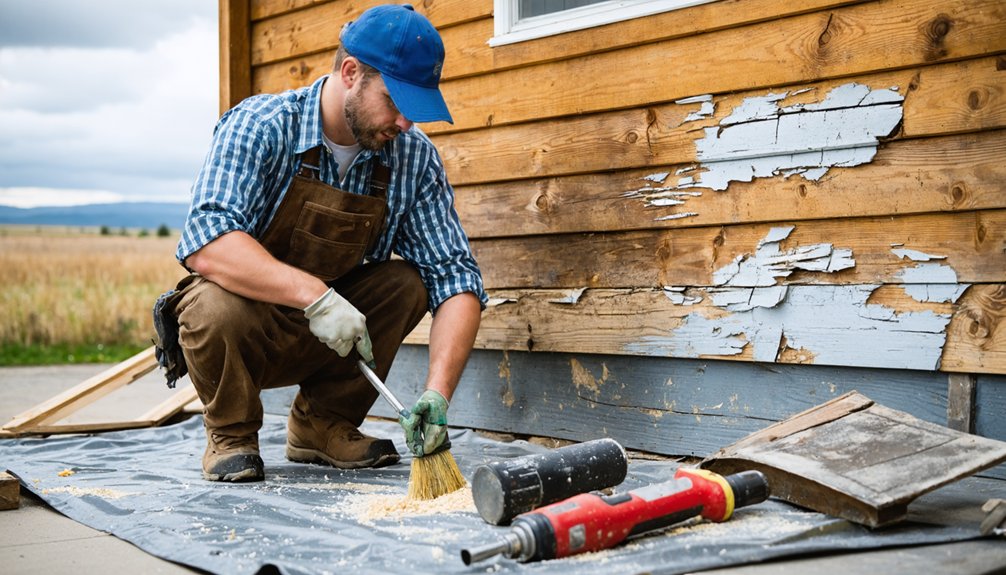
Every successful exterior paint job depends on methodical pre-paint problem resolution—shortcuts here guarantee premature coating failure.
We’ll start by inspecting all four elevations, using binoculars for high zones to document peeling, chalking, and water stains. Identifying wood rot requires probing suspect areas for soft, spongy texture requiring replacement before any coating application.
We’ll scrape all delaminating paint with pull-style scrapers, feathering edges smooth to eliminate telegraph-through. Check active leak sources at soffits, gutters, and penetrations—moisture intrusion must be corrected first. Address mold with spore-killing cleaner, not household bleach.
Remove deteriorated caulk and reapply paintable elastomeric product at all joints. Evaluating exterior lighting needs now prevents access complications post-paint.
For pre-1978 construction, EPA-compliant lead-safe practices aren’t optional—they’re mandatory protocol protecting everyone involved.
Proper Cleaning and Priming Techniques for Different Surfaces
Once you’ve resolved substrate defects and replaced compromised materials, surface preparation shifts to contaminant removal and primer application—the two factors that determine coating longevity more than paint quality itself. We’ll pressure wash your Hazelton home to eliminate dirt accumulation that prevents proper adhesion. In Idaho’s 80°F climate, surfaces typically dry overnight.
For homes built before 1978, we’ll conduct lead paint testing before scraping any deteriorated coatings—residue disposal methods must comply with EPA standards.
After scraping to sound substrate, we’ll sand feathered edges and apply targeted primers:
- Acrylic primers for standard substrates post-sanding
- Oil-based primers on cedar or redwood to lock tannins
- Peel Bond primer to seal compromised edges and prevent future delamination
We’ll tint primers contrasting your topcoat to identify missed coverage spots during application.
Managing Temperature and Humidity During Application
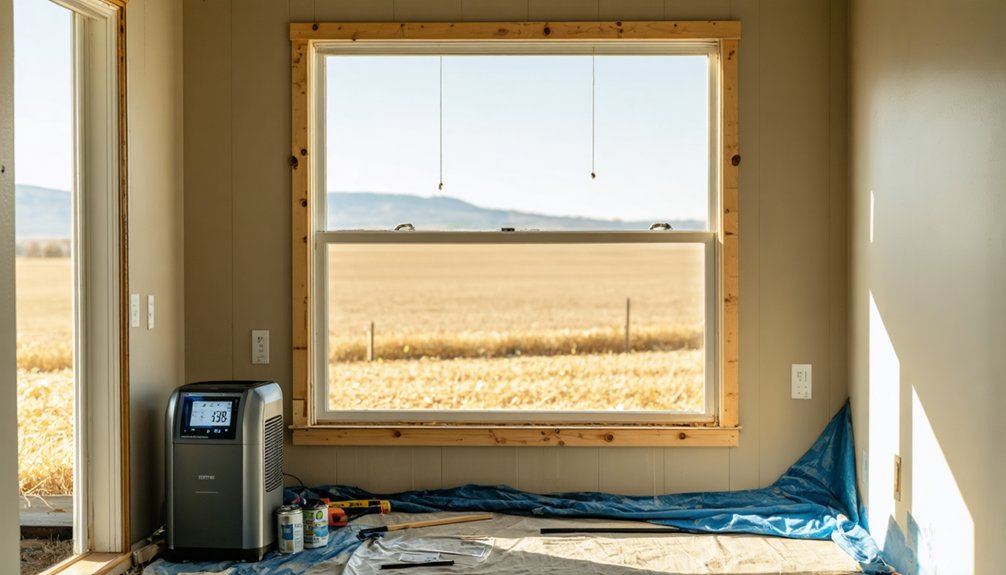
Temperature and humidity create molecular-level conditions that either facilitate or prevent proper paint film formation—we can’t override thermodynamic realities with premium products alone. In Hazelton’s climate, we’ll encounter seasonal temperature swings that demand vigilant ideal conditions monitoring.
We’re targeting 50°F to 85°F for surface, paint, and ambient temperatures, with humidity between 40% and 70%. Below 50°F, we’ll see compromised adhesion and extended cure times. Above 85°F, we risk rapid solvent evaporation causing lap marks and incomplete cross-linking.
Deploy dehumidifiers when humidity exceeds 70%, and use space heaters to maintain minimum thresholds. We’re controlling airflow with strategic fan placement and timing applications for midday temperature peaks. Thin coats accelerate drying cycles while maintaining film integrity throughout curing phases.
Protecting Your Investment With Proper Maintenance After Painting
How do we extend the lifespan of a freshly painted surface beyond its expected performance window? We implement systematic maintenance protocols that address wear before it escalates into costly restoration projects. Our approach combines regular inspection cycles with proactive intervention strategies.
Core maintenance framework:
- Touch up techniques require precise color matching and proper surface preparation—scraping loose material, applying primer to bare spots, and feathering edges for seamless integration
- Paint revitalizing schedules follow a 5-7 year timeline, adjusted based on exposure conditions and observed deterioration patterns
- Cleaning protocols utilize mild soap applications within initial months, transitioning to low-pressure washing after cure completion, maintaining 6-12 month intervals
We’ve learned that early detection of bubbling, peeling, or moisture infiltration prevents extensive damage. Professional assessment becomes essential when structural indicators emerge, protecting our collective investment in quality finishes.
Frequently Asked Questions
How Much Does Professional Exterior Painting Cost in Hazelton, Idaho?
We’ve found professional exterior painting costs $1,900 to $4,500 in Hazelton, Idaho. Factors affecting exterior painting costs include surface preparation, materials quality, and project complexity, while average hourly painting rates typically reflect regional labor standards and contractor expertise levels.
Do I Need a Permit to Paint My Home’s Exterior?
No, you won’t need a permit for exterior painting in Hazelton. We always recommend confirming local regulations with City Hall at 208-829-5415 beforehand, ensuring your project aligns with current painting guidelines and jurisdiction-specific requirements.
How Long Does Exterior Paint Typically Last in Idaho’s Climate?
In Idaho’s climate conditions, we’ll typically see exterior paint longevity ranging from seven to ten years. However, Hazelton’s high elevation and intense UV exposure can accelerate deterioration, requiring us to monitor for chalking, fading, and film breakdown more frequently.
Should I Paint My Home Myself or Hire a Professional?
We recommend hiring professionals for most homeowners. DIY challenges include achieving uniform coverage and proper surface preparation, while time commitment considerations often exceed 40-70 hours for average homes. Professional results typically last twice as long with warranted finishes.
What Colors Are Most Popular for Homes in Hazelton?
While vibrant colors tempt homeowners, we’ve found neutral tones and earthy hues dominate Hazelton’s residential palette. Taupe, greige, and sage green provide excellent substrate compatibility with Idaho’s landscape while ensuring long-term color retention in our high-UV climate.