We’ve identified five critical indicators that signal your home needs repainting: chalking (white powdery residue when you touch the siding), visible fading with uneven sheen patterns, paint bubbling or peeling that exposes substrate to moisture infiltration, cracking that creates pathways for water penetration, and weathering lines between sun-exposed and shaded sections. These aren’t merely cosmetic concerns—they represent progressive failure of your protective barrier system. We’ll explain how each symptom develops, the structural risks involved, and the cost implications of delayed intervention.
Key Takeaways
- Chalky white residue on fingers when touching siding indicates UV-degraded paint requiring immediate repainting to prevent substrate damage.
- Bubbling, peeling, or cracking paint signals moisture infiltration or structural issues demanding prompt attention to avoid costly repairs.
- Faded colors with uneven sheen and visible weathering lines between shaded and sun-exposed areas indicate compromised protective barrier.
- Eroded caulking around windows and doors creates water infiltration pathways that can cause interior damage and wood rot.
- Outdated paint colors reduce property value by 2-5% while fresh exterior coating delivers 50-100% return on investment.
Fading and Discoloration: The First Warning Sign
When paint begins to fade or discolor, it’s signaling the breakdown of critical chemical bonds within the pigment structure. We’ve observed that UV radiation systematically degrades these bonds, particularly on southern and western exposures where sunlight hits hardest. You’ll notice uneven paint sheen developing across your siding—those dull, chalky patches contrasting with protected areas.
Visible weathering lines often appear at the junction between shaded and sun-exposed sections, creating distinct demarcation zones.
Run your hand along faded surfaces. If you’re seeing white residue on your fingers, that’s chalking—direct evidence of pigment deterioration. This powder indicates your paint’s protective resin layer has compromised. We can’t overstate this: fading isn’t merely cosmetic. It represents active failure of your home’s defensive barrier against moisture infiltration and substrate degradation.
Peeling, Cracking, and Chipping Paint
We’ve learned that bubbling paint isn’t just cosmetic—it’s your home signaling trapped moisture that’ll rapidly escalate into structural wood rot if ignored. The damage compounds exponentially once water penetrates behind the paint film, turning a simple surface repair into expensive substrate replacement and remediation work.
Early Warning Bubbling Paint
Though bubbling paint might appear as minor cosmetic damage, it signals underlying structural issues that demand immediate attention. We’ve learned through countless projects that these blisters indicate adhesive failure between your paint and substrate.
When you notice bubbles forming, we’re detecting one of three culprits: moisture infiltration through compromised siding, improper surface preparation during the previous application, or extreme heat exposure causing expansion.
Effective moisture detection starts with examining popped bubbles—if water releases, you’re facing substrate dampness requiring immediate remediation. We can’t stress enough that ignoring these warning signs leads to extensive rot and structural deterioration.
Temperature fluctuations, UV degradation, and incompatible paint formulations accelerate this process. Address bubbling immediately before minor surface issues become costly repairs demanding complete siding replacement.
Structural Damage From Neglect
Beyond surface aesthetics, peeling and cracking paint exposes your home’s substrate to accelerated deterioration that compounds exponentially with each passing season. We’ve observed how moisture penetration through compromised paint film initiates wood strength reduction at the cellular level.
Once water breaches your exterior coating system, it doesn’t simply sit on the surface—it migrates through wall cavities, causing potential interior damage that extends far beyond what’s visible from the curb. The rot we encounter during restoration projects rarely announces itself until structural integrity is severely compromised.
Eroded caulking around windows and doors creates direct pathways for water infiltration, while failing gutters redirect moisture exactly where you don’t want it. We’ve learned that addressing paint failure isn’t cosmetic maintenance—it’s essential structural preservation.
Minimize Prep Work Costs
When paint begins detaching from your substrate—whether through peeling, cracking, or chipping—you’re looking at preparation costs that’ll escalate your project budget by $1-$2 per square foot before the first finish coat touches your siding. We’ve learned that catching these failures early dramatically reduces expenses.
Spot-scraping isolated peeling prevents full-surface intervention, while quality primer application on exposed chips guarantees superior adhesion that’ll extend lifespan of paint by 25%. Power washing annually stops cracking progression before moisture infiltrates beneath film layers.
When you identify problematic substrates like aging wood, targeted caulking saves 15% in labor costs compared to extensive repairs. Multi-story access doubles prep expenditure, so prioritizing high-exposure zones—eaves, southern elevations—concentrates resources where deterioration accelerates fastest.
Strategic intervention beats reactive overhaul every time.
Chalking: A Powdery Residue on Your Exterior
We’ve encountered chalking on countless exterior paint jobs—that distinctive white, powdery residue that forms when UV radiation degrades the paint binder and releases pigment particles to the surface. This weathering phenomenon differs from peeling or cracking because you can easily wipe away the chalky film with your hand, though what appears as harmless dust actually signals compromised paint integrity.
Understanding what chalking looks like, its underlying causes, and when it necessitates complete repainting will help you protect your home’s exterior from accelerated deterioration.
What Chalking Looks Like
If you notice a fine, powdery substance forming on your home’s exterior walls, you’re likely dealing with paint chalking—a common degradation where the paint film’s binders break down under prolonged UV exposure and weather cycles.
We can identify this issue by running our fingers across the surface—if a chalky residue transfers to our skin or a dark cloth, we’ve confirmed chalking. It appears as a faded, dusty coating that diminishes curb appeal, particularly noticeable on darker colors and flat sheens compared to glossy paint sheen.
This isn’t dust, mold, or dirt—it’s actual paint erosion creating color-matched powder. Among common paint problems, chalking signals that our exterior needs attention before moisture penetration causes peeling, cracking, or structural damage.
Causes of Paint Chalking
Understanding what causes paint chalking helps us prevent this degradation before it compromises our home’s protection. UV radiation breaks down paint binders, releasing pigment particles as powdery residue—a process accelerated on darker colors that absorb more heat. Inferior paint formulation compounds this issue, as budget products contain weak binders and lack UV-resistant additives.
We often see oil-based coatings chalk faster than modern acrylics, particularly in high-UV environments.
Inadequate surface preparation creates conditions where moisture penetrates porous substrates like concrete and stucco, undermining paint adhesion. Application errors—over-thinning, insufficient film thickness, or skipping recommended coat counts—weaken our protective barrier. Environmental factors like coastal salt, humidity fluctuations, and temperature extremes further accelerate binder degradation, making proper material selection and surface prep essential for long-term performance.
When Chalking Requires Repainting
When we run our hand across a painted exterior surface and encounter white powdery residue, we’re observing chalking—a clear indicator that the paint’s protective barrier has degraded beyond acceptable thresholds. This chalky texture confirms we’ve reached the end of our paint’s serviceable lifespan. The moment residue transfers easily to our hands, we’re facing immediate repainting requirements—our home’s exterior no longer shields against moisture infiltration and UV exposure.
We recognize this as critical timing. Delaying action invites premature peeling, wood rot, and accelerated surface deterioration. We’ve learned that signs of oxidation progress rapidly once chalking appears. Our protocol involves washing away residue, repairing compromised surfaces, and applying premium-grade coatings. For wood siding applications, we maintain 5-7 year repainting intervals to prevent such degradation.
Wood Damage and Rot
Wood rot compromises the structural integrity of exterior surfaces and undermines paint adhesion, making early detection critical for any homeowner planning an exterior painting project. We’ve learned to identify telltale signs: soft or spongy spots when pressing trim, dark staining that spreads like mildew, and crumbly edges on corner boards. Window sills, door frames, and fascia boards are particularly vulnerable to moisture intrusion.
Paint failure often signals underlying rot—bubbling, peeling, or alligatoring that returns after repainting indicates compromised wood surface integrity. We can’t simply paint over damaged areas. Professional repair requires removing affected sections, treating exposed surfaces, and replacing deteriorated materials to restore structural stability. Addressing rot during prep work guarantees your new coating system performs as intended and protects your investment for years ahead.
Mold and Mildew Growth on Siding
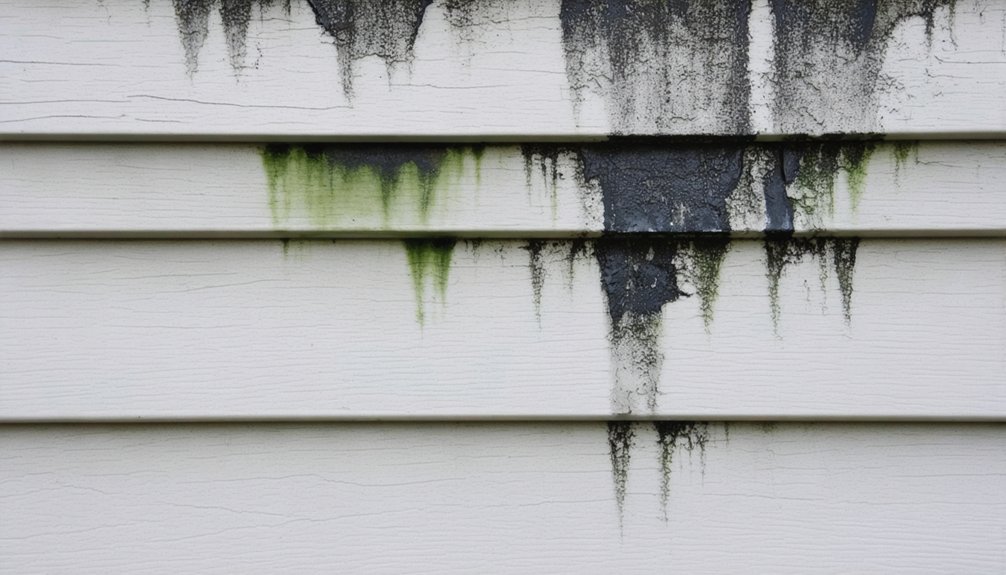
Mold and mildew colonies establish themselves quickly on exterior siding when moisture conditions align—typically within 24 to 48 hours of sustained exposure above 60% humidity. We’ve observed mold infiltration patterns beginning as small black, green, or gray specks that develop into fuzzy patches near seams and gaps.
Visible condensation issues accelerate this growth, creating tide-line stains and dark discoloration that penetrate beneath paint layers. When you notice peeling or bubbling paint, it’s signaling trapped moisture beneath the surface—prime conditions for hidden colonies.
That persistent musty odor outside isn’t normal; it indicates growth behind your siding. We recognize spots returning after cleaning as confirmation of ongoing moisture penetration requiring immediate attention, not just another coat of paint.
Caulking and Sealant Failure
We’ve seen countless exterior paint failures traced directly to compromised caulking and sealants that no longer protect critical joints and seams. When caulk loses its adhesion and flexibility, moisture penetrates through cracks and separations at windows, doors, and trim—creating conditions for wood rot, paint blistering, and even pest infiltration.
Recognizing the visual signs of caulk breakdown and understanding proper recaulking intervals will prevent costly structural damage and preserve your home’s protective envelope.
Signs of Caulk Breakdown
Caulk deterioration manifests through distinct visual indicators that signal compromised weather protection around your home’s exterior. We’ve identified key caulk deterioration indicators including cracking around windows and door jambs, gaps forming between sealant and surfaces, and substrate separation. These failures create pathways for moisture infiltration, pest access, and accelerated wood rot.
During inspections, we focus on vulnerable juncture points where siding meets trim, corner assemblies, and frame connections. Surface splits expose underlying materials to weather damage, particularly problematic in freeze-thaw cycles. We recommend seasonal assessments to establish ideal recaulking intervals before deterioration escalates.
When we identify compromised caulk during exterior painting evaluations, we address it immediately. Proper recaulking precedes repainting—it’s essential surface preparation that ensures comprehensive weather protection and prevents costly structural repairs.
Moisture and Pest Entry
Failed sealants create two critical vulnerabilities in your home’s exterior envelope: moisture infiltration and pest access points. We’ve observed that gaps as small as 1/16 inch provide entry for ants, termites, and wood-boring insects seeking damp wood beneath compromised paint.
When water penetrates through cracked caulk, it softens substrates and attracts pests to these weakened areas. Dark streaks and bubbling paint signal active moisture intrusion that’s already creating ideal conditions for pest infestation risks.
Beyond structural concerns, failed caulking eliminates energy efficiency benefits by allowing conditioned air to escape while introducing drafts. We recommend immediate attention to shrinking or missing caulk around windows, doors, and trim joints—these aren’t merely cosmetic issues but critical defense points protecting your home’s integrity and comfort.
When to Recaulk
Before moisture damage escalates into structural compromise, homeowners must recognize the telltale signs that caulking has reached the end of its service life. We’ve identified key failure indicators: shrinkage where caulk pulls away from window and door edges, visible cracking at trim-to-siding junctures, and peeling that lifts from surfaces. When gaps exceed half an inch or air leaks become detectable, caulk replacement becomes non-negotiable.
We focus recaulking efforts on trim joints, corners, and drip edge connections while avoiding overlapping boards, weep holes, and metal flashing—areas requiring ventilation and drainage. Appropriate caulk selection prioritizes elastomeric formulations with mold resistance for exterior applications. Our experience confirms that quality sealant application, following proper surface preparation and 45-degree tube cutting, prevents costly structural repairs down the line.
Moisture Stains and Water Damage
Water damage reveals itself through distinct visual markers that experienced painters recognize immediately. Dark streaks running down your walls typically indicate damaged gutters or roof runoff problems—constant exposure breaks down even premium coatings. Authorities are aware of persistent stains near downspouts and windows, which signal active moisture intrusion requiring immediate attention.
Bubbling and blistering occur when water penetrates beneath the paint film, trapping moisture and creating pockets that precede widespread peeling. Rust-colored stains around nail heads and metal fixtures confirm that moisture has compromised the protective barrier, reaching underlying substrates.
Black patches or green streaks in shaded areas indicate mold growth where the paint’s mildewcide has failed. When these biological markers resist washing, experts are cognizant of the moisture barrier has deteriorated completely, demanding professional intervention.
Exposed Bare Surfaces
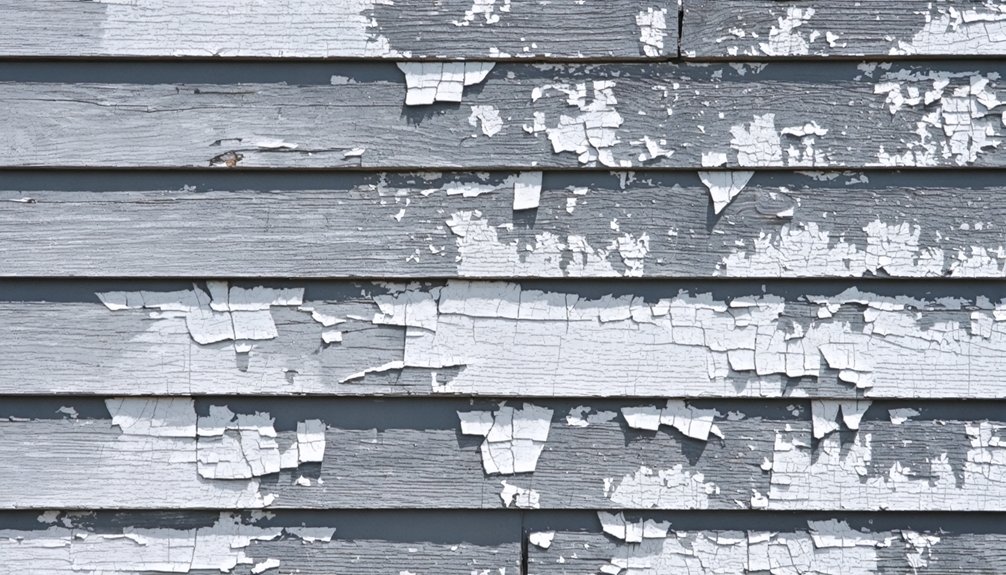
When paint films fail completely, exposed substrates tell us exactly how long deterioration has progressed. We’ll find bare wood, hardy board, or aluminum siding where protective coatings have surrendered to weather. These naked areas demand immediate attention—spot priming with oil or shellac-based products becomes non-negotiable before any topcoat application.
Surface discoloration around windows, doors, and trim signals moisture intrusion we can’t ignore. What starts as small peeling spots spreads rapidly, compromising structural integrity. We’re seeing hidden damage that extends beyond visible deterioration—water seepage behind failed paint films causes rot we won’t detect until removal begins.
Exposed surfaces require complete preparation protocols. We’ll scrape, prime, and seal these vulnerable zones before full repainting. Delaying this intervention only multiplies repair costs and extends project timelines considerably.
Outdated and Unappealing Colors
Color trends cycle through predictable phases—saturation, acceptance, oversaturation, then decline—and we’re witnessing several once-popular exterior palettes reach obsolescence in 2025. High-gloss black, despite its modern farmhouse appeal, now feels repetitive and creates market saturation issues. Builder beige and muddy browns signal dated design while reducing curb presence.
Navy blue’s once-fresh aesthetic has become predictable, with heat absorption and fading concerns diminishing its practical value. Ultra-bright primaries overwhelm architectural details and create neighborhood discord. We’ve observed that buyer preferences increasingly favor authenticity over trend-chasing, with Zillow data confirming neutrals risk appearing tired despite broad appeal.
When your exterior displays these obsolete palettes, you’re signaling deferred maintenance rather than timeless design—a liability in competitive real estate markets where first impressions determine value.
How Repainting Protects Your Investment
Beyond aesthetic missteps, deteriorating or outdated exterior paint creates measurable financial vulnerabilities that we’ve documented across thousands of projects. Professionally applied exterior coatings deliver 50-100% ROI—outperforming most renovations while providing critical substrate protection against moisture intrusion, UV degradation, and pest infiltration.
Our field data confirms properly maintained exteriors achieve 2-5% increased property value, translating to $15,000 gains on typical $300,000 properties. This improved curb appeal directly influences appraisal outcomes, enabling better refinancing terms and eliminating PMI requirements for equity-positioned homeowners.
The protective barrier we establish prevents costly structural repairs by deterring termite invasion, wood rot, and elemental damage. Quality paint systems extend siding longevity while maintaining market competitiveness. We’ve observed $50,000 higher selling prices in competitive markets when properties feature freshly coated exteriors.
Frequently Asked Questions
What Is the Average Cost to Repaint a House Exterior?
We’ve found exterior paint maintenance cost typically ranges from $2,500 to $7,000 nationally, averaging $3,177. When house painting budgeting, expect $1.50 to $4 per square foot, though regional factors and siding materials greatly impact your final investment.
How Long Does a Professional Exterior Paint Job Typically Take?
Rome wasn’t built in a day—we’ll typically complete your exterior paint job in 3-7 days. Project timeline depends on your home’s size and complexity, while painting crew size of 3-4 professionals guarantees quality results without sacrificing efficiency.
What Time of Year Is Best for Exterior House Painting?
We recommend spring and fall for ideal exterior painting when weather conditions stabilize between 50°F-85°F with moderate humidity. Climate impact matters—these seasons minimize precipitation risks and temperature extremes that compromise paint adhesion and curing performance.
Should I Use Oil-Based or Latex Paint for Exterior Surfaces?
We recommend latex paint for most exterior surfaces due to superior paint finish durability and flexibility. However, paint application considerations like substrate condition matter—oil-based excels on chalky surfaces and existing oil finishes where we need maximum adhesion.
Do I Need Permits to Repaint My Home’s Exterior?
Most exterior repainting doesn’t require permits—we’ve handled countless projects without them. However, we always verify local zoning regulations and paint contractor requirements with your building department first, especially if you’re in historic districts or HOA communities.