We’ve found that professional exterior house painting typically costs between $1,800 and $5,000, with a national average of $3,177. You’ll pay $1.50–$4.37 per square foot depending on your siding material, home size, and paint quality. Single-story homes run $1,500–$6,000, while two-story properties cost $4,500–$10,000. Premium paints ($60-$80/gallon) deliver 8-10+ years of durability compared to budget options at $28.87/gallon with 3-5 year lifespans. We’ll break down how square footage, stories, siding type, and preparation work impact your project’s bottom line.
Key Takeaways
- Professional exterior house painting costs between $1,800 and $5,000, with a national average of $3,177.
- Pricing scales at $1.50–$4.37 per square foot, depending on home size, stories, and siding material.
- Two-story homes cost $4,500–$10,000, while three-story structures can exceed $12,000 due to specialized equipment needs.
- Premium paints cost $60–$80 per gallon but last 8–10+ years, versus budget options at $28.87 with 3–5 year lifespans.
- Brick and stucco require extensive preparation costing $4,000–$12,000, significantly increasing total project expenses.
Average Cost to Paint a House Exterior
Professional exterior house painting costs between $1,800 and $5,000 for most residential projects, with the national average settling at $3,177. However, the full cost spectrum extends from $600 to $7,700 depending on project complexity and specifications.
We’re seeing industry data from CertaPro Painters reporting a higher national average of $4,839.33, while Digital Estimating places the range between $3,500 and $8,500. These variations reflect local market conditions and paint contractor selection criteria in different regions.
The most reliable pricing metric contractors use is the per-square-foot rate, typically ranging from $1.50 to $4.00. Current 2026 estimates suggest $2.20 to $4.37 per square foot, though some markets report higher rates between $4.25 and $7.95 depending on material specifications and surface preparation requirements.
Cost Breakdown by Square Footage
Square footage represents the primary pricing variable for exterior painting projects, with costs scaling predictably from $1.50 to $4.37 per square foot across residential applications.
Exterior painting costs scale predictably at $1.50–$4.37 per square foot, with total square footage serving as the dominant pricing factor.
For an 800-square-foot home, we’re looking at $1,800–$3,500, while 1,000 square feet ranges from $1,500–$4,400. Mid-sized homes at 1,500 square feet typically cost $2,250–$6,000, with industry data showing $4,197 as the average.
A 2,000-square-foot project runs $3,000–$8,800, depending on surface complexity. Larger properties escalate proportionally—2,500 square feet costs $3,750–$11,000, while 3,000 square feet reaches $4,500–$12,000. These figures incorporate labor, materials, and surface preparation.
Primary home characteristics like siding type and architectural details influence final costs, as do regional cost variations affecting contractor rates and material availability in your market.
Pricing Based on Number of Stories
We’ve analyzed how the number of stories directly impacts exterior painting costs, with single-story homes ranging from $1,500–$5,000, two-story properties averaging $2,500–$7,500, and three-story structures reaching $4,000–$10,000+.
Each additional level increases labor expenses by up to 50% due to scaffolding requirements, specialized equipment, and extended setup time.
We’ll break down the specific cost premiums for single-story, two-story, and three-story homes to help you budget accurately for your project’s vertical complexity.
Single-Story Home Costs
Painting a single-story home typically costs between $1,500 and $6,000, depending on square footage and project specifications. We’ve found that pricing averages $1.50 to $4 per square foot, with a 1,000 sq ft home running around $2,500 and 1,500 sq ft properties near $3,300. Single story material costs include quality exterior paint at $50 to $100 per gallon, while labor dominates at $1 to $2 per square foot or $25 to $100 hourly per painter.
Single story home preparation dramatically impacts your final price. We include power washing, caulking, and surface repairs in our estimates. Your siding type matters—wood runs $1 to $3 per square foot, while brick costs $1.50 to $4.50. Two-coat applications for 1,500 sq ft homes range from $6,800 to $8,000, compared to $5,500 to $6,500 for single coats.
Two-Story Painting Expenses
Two-story exterior painting commands 40-50% higher costs than single-story projects, with total expenses ranging from $4,500 to $10,000 for typical residential applications. The increased investment reflects specialized equipment requirements and contractor expertise needed for elevated surfaces.
Critical Cost Factors for Two-Story Projects:
- Scaffolding and Access Equipment – Professional-grade staging systems add $800-$2,000 to base costs, ensuring safe reach to upper surfaces and trim details.
- Extended Labor Requirements – Setup, positioning, and repositioning equipment increases billable hours by 30-40%, with rates of $25-$100 per hour depending on regional markets.
- Weather Resistance Specifications – Upper-level exposure demands premium coatings engineered for enhanced UV protection and moisture barriers, averaging $50-$70 per gallon versus standard formulations.
Per-square-foot pricing typically ranges $3.45-$7.95, with most homeowners investing $7,582 for 2,500-square-foot applications.
Three-Story Price Premium
Three-story residential exteriors command the highest market premiums in exterior painting, with project costs ranging from $4,500 to $12,000 depending on square footage and regional labor rates. We’re looking at approximately 50% cost escalation per story above baseline pricing, translating to $1.50 to $4 per square foot with substantial labor allocation increases.
Scaffold installation represents the primary cost driver, typically adding $800 to $2,000 to project totals. Accessibility logistics become exponentially more complex at this elevation, requiring specialized equipment rental, extended setup protocols, and enhanced safety compliance measures. Labor rates of $25 to $100 per hour compound these expenses, while material requirements increase proportionally with expanded coverage areas. Professional contractors factor these accessibility challenges into thorough estimates, ensuring proper equipment deployment and regulatory adherence throughout three-story project execution.
Cost Differences by Siding Material
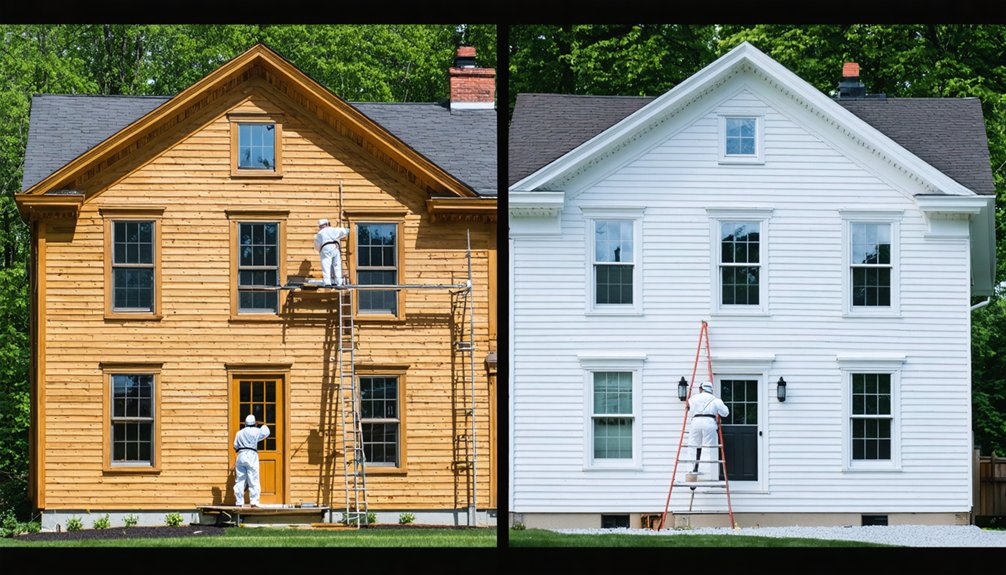
We’ll examine how siding material directly impacts your exterior painting costs, as each substrate requires different preparation methods, paint products, and labor intensity.
Wood and vinyl represent the lower end of the cost spectrum at $1.70–$5.20 per square foot, while masonry options like brick and stucco command premium rates of $2.50–$5.00 per square foot due to their porous surfaces and specialized coating requirements.
These price variations stem from measurable differences in paint absorption rates, surface preparation demands, and the technical expertise needed for proper application.
Wood vs. Vinyl Siding
While both materials serve the same protective function, wood and vinyl siding differ noticeably in painting costs and long-term financial implications.
Initial Investment and Maintenance Timeline:
- Upfront Installation Costs: Wood siding runs $5–$15 per square foot installed, while vinyl costs $2–$7 per square foot—making vinyl considerably more budget-friendly from the start.
- Painting Frequency: Wood requires sealant application and repainting every 3–7 years to maintain siding appearance, whereas vinyl needs only periodic hose-downs once or twice annually.
- Material Longevity Analysis: Wood delivers 15–25 years of service with diligent maintenance and pest treatment. Vinyl offers superior durability through UV-resistant technology that prevents fading, cracking, and warping while naturally resisting termites and carpenter ants.
When we calculate cost per year of coverage, vinyl’s lower maintenance burden provides stronger long-term ROI for most homeowners.
Brick and Stucco Costs
Brick and stucco represent the premium end of exterior painting projects, with brick commanding $1.50–$4.50 per square foot and stucco running slightly lower at $1.50–$4.00 per square foot. The brick vs stucco finish comparison reveals critical cost drivers: brick’s porous texture demands specialized masonry primer requirements at $20–$50 per gallon, while stucco’s smoother surface reduces absorption by 10–20%.
We’re looking at labor increases of 20–30% for brick due to surface roughness requiring additional passes. Masonry paint coverage averages 250 square feet per gallon on brick versus stucco’s more efficient application. For your 2,500-square-foot project, expect $3,500–$10,500 for brick or $3,750–$10,000 for stucco—both requiring breathable formulations to prevent moisture entrapment and substrate damage.
Paint Quality and Material Expenses
When selecting exterior paint, material costs span a wide spectrum—from budget-friendly options at $28.87 per gallon (Behr) to premium formulations like Sherwin-Williams Duration at $60-$80 per gallon. However, we’ve found that upfront savings rarely translate to long-term value when you factor in product longevity and color retention.
Understanding Paint Quality Tiers:
- Budget paints ($28-$40/gallon): Thin consistency requiring multiple coats, typical 3-5 year lifespan with noticeable fading and chipping in harsh climates.
- Premium paints ($60-$80/gallon): Higher solids content delivers 250-300 sq. ft. coverage, superior UV and humidity resistance, 8-10+ year durability.
- Ceramic coatings ($9,000+ total): Rhino Shield provides up to 25 years of minimal-maintenance protection—eliminating frequent repainting cycles entirely.
Labor Costs vs. DIY Savings
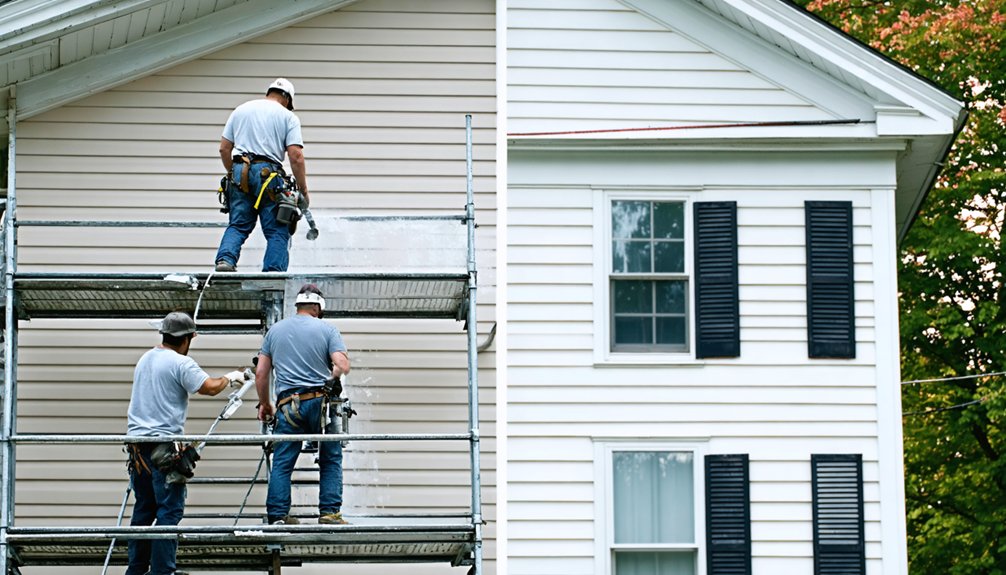
However, DIY quality tradeoffs warrant serious consideration. We’ll need proper equipment, scaffolding for multi-story applications, and safety gear.
Prep work demands meticulous attention: power washing, patching, caulking, and potential paint stripping. Without professional expertise, we risk discovering structural issues like rot that require specialized intervention, diminishing our savings.
The time investment and technical skill requirements often make professional execution the more cost-effective choice for complex projects.
Factors That Affect Your Final Price
Several variables compound to determine exterior painting costs, with surface area serving as the primary cost driver. We’ve identified key factors that directly impact your investment:
- Surface Area and Project Complexity – Multi-story homes require scaffolding and specialized equipment, adding $1,500–$4,000 per story. Contractors price at $2–$6 per square foot, with intricate trim and hard-to-reach areas extending the painting timeline.
- Siding Material – Different substrates demand specific approaches: brick needs extensive cleaning ($4,000–$12,000), while wood siding runs $1,000–$4,000. Fiber cement and stucco require specialized primers and breathable coatings.
- Preparation Requirements – Poor surface conditions double prep time. Power washing, crack repairs, and existing paint removal greatly escalate labor costs before the first coat applies.
Each element compounds to shape your total project investment.
Frequently Asked Questions
How Often Should I Repaint My House Exterior?
We recommend repainting every 7-10 years, though painting schedule considerations vary based on siding type and climate. The environmental impact of paint degradation accelerates in coastal or harsh conditions, potentially requiring more frequent applications to maintain protection and curb appeal.
What Is the Best Time of Year to Paint?
We’ve found spring and fall hit the sweet spot for exterior painting. These seasons deliver ideal weather conditions—50-85°F with 40-70% humidity—creating the perfect time frame that maximizes paint adhesion while minimizing costly application failures.
Do I Need to Prime Before Painting the Exterior?
We’ll need primer if your exterior surface condition shows peeling, chipping, or bare wood. Proper paint preparation steps require priming damaged areas to guarantee adhesion and durability, though it’ll increase your project costs and timeline.
How Long Does Exterior House Paint Typically Last?
Like armor protecting your castle, we’ll see exterior paint last 5-10 years typically. However, paint quality and weather conditions directly impact longevity—premium acrylics in moderate climates reach 10+ years, while harsh UV or coastal exposure shortens it to 5-7 years.
Does Exterior Paint Color Affect the Cost?
Color selection doesn’t appreciably impact our exterior painting costs—you’ll pay the same for most standard hues. However, we’ve found that paint sheen choices and premium custom colors can add 10-20% to your material expenses.